What I Built (In Plain English)
Managing a commercial vehicle fleet requires tracking thousands of GPS devices at once. Each tracker sends bursts of raw binary data every second—reporting location, speed, fuel consumption, engine diagnostics, and sudden impacts.
I built a high-throughput IoT telematics ingestion pipeline that decodes these binary packets from industrial Teltonika trackers in real time, validates hardware checksums, checks for geofence breaches, and streams live vehicle movements to an interactive mission control dashboard.
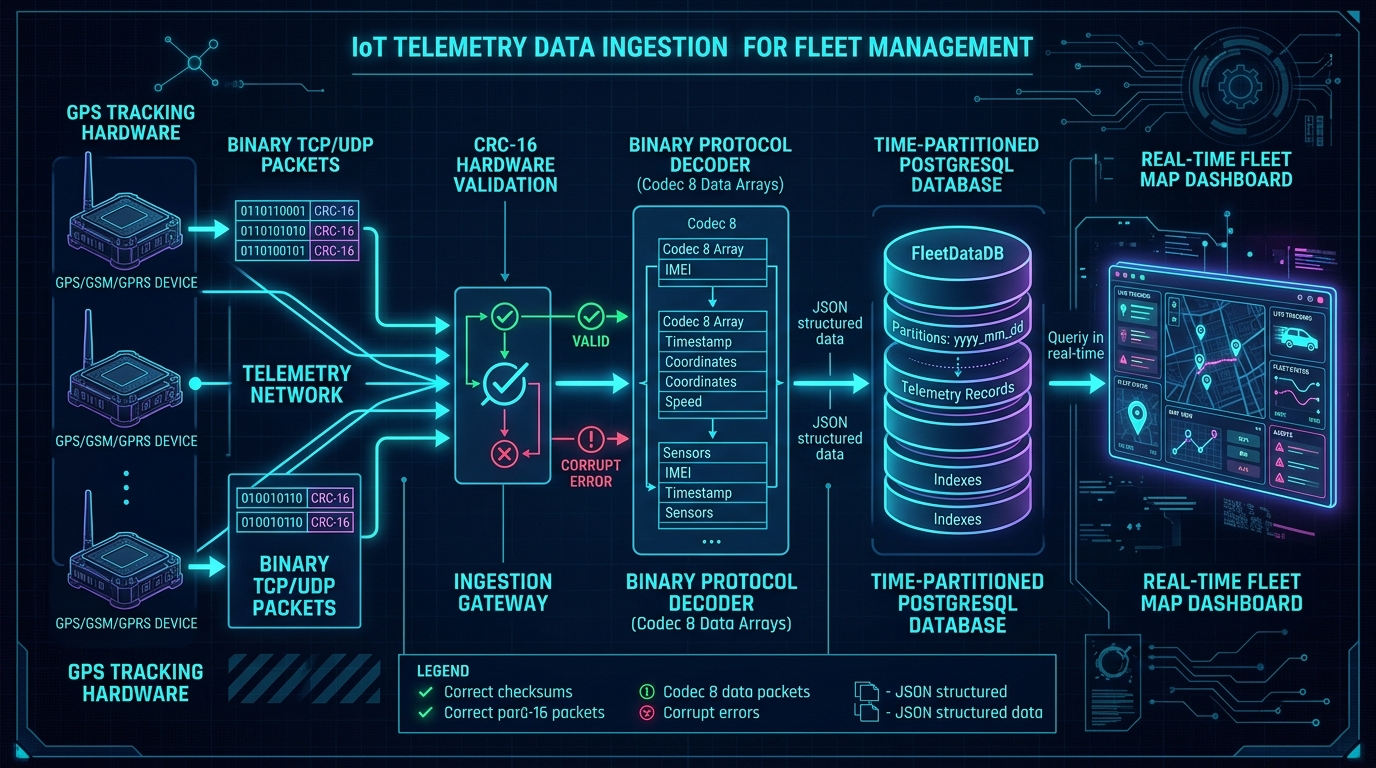
⚠️ Tech Ahead: The sections below detail the Teltonika Codec 8 / Codec 8 Extended binary parsing algorithms, CRC-16 hardware handshake mechanics, time-partitioned PostgreSQL ingestion, and real-time event distribution.
Data Pipeline Architecture
[Teltonika Hardware] (TCP/UDP Binary Packets)
        │
        ▼
[High-Performance Ingestion Daemon] (Node.js / C++ Gateway)
        │ • CRC-16 Validation
        │ • Codec 8 / Codec 8 Extended Binary Parsing
        │ • AVL Data Array Extraction
        ▼
[Event Broker & Validation Pipeline]
        │ • Speed & Geofence Threshold Checks
        │ • Sensor Normalization (Fuel, Battery, CAN-bus)
        ▼
[Storage Layer] ────────► [Mission Control Dashboard]
PostgreSQL / Prisma       Next.js Real-Time Map & Alert UI
Technical Specifications
- Binary Protocol Decoding: Implemented custom parsers for Teltonika Codec 8 and Codec 8 Extended binary protocols, decoding multi-IO records, GNSS coordinates, and sensor flags with zero memory leaks.
- Packet Verification: Enforces rigorous CRC-16 validation and sends automated hardware acknowledgment frames (
0x000000XX) within strict timeout windows to prevent device retransmission storms. - Optimized Database Ingestion: Batched writes into PostgreSQL utilizing time-partitioned schemas to sustain millions of coordinate updates without degrading indexing performance.
- Real-Time Fleet Visualizer: Reactive dashboard tracking vehicle routes, idle durations, driver behavior, and instant geofence breach notifications.
— [ DISPATCH TRANSMISSION COMPLETE // END OF FILE ] —