What I Built (In Plain English)
Web applications often struggle with multithreading and raw rendering speed, while building separate native apps for Apple, Android, and desktop requires writing the same UI three or four times.
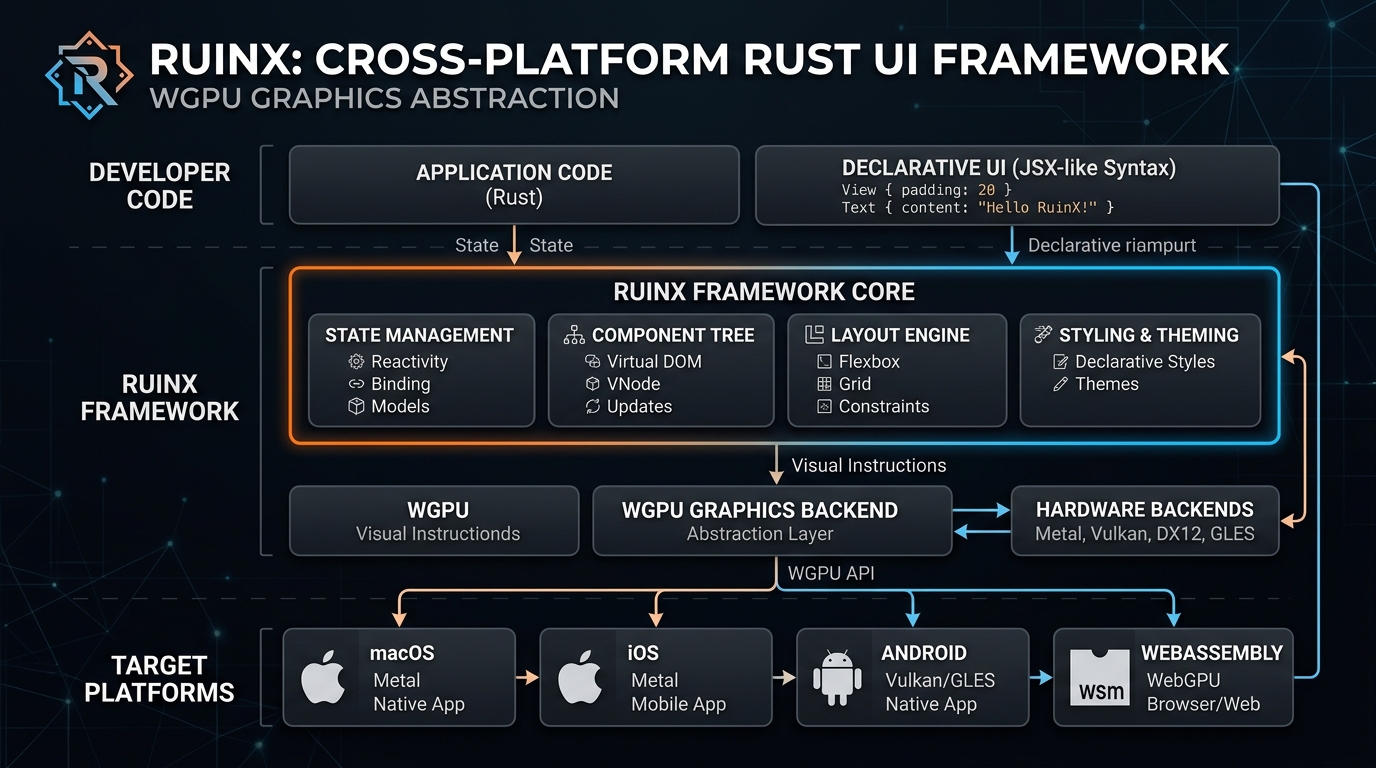
I started RuinX (Rust UI NeXt)—an open-source cross-platform UI framework. It brings declarative, React-like ergonomics to pure Rust, allowing developers to write an interface once and render it at 60+ FPS natively on macOS, iOS, Android, and the web using modern GPU acceleration.
⚠️ Tech Ahead: The sections below explore the Rust component virtual tree, declarative macro syntax, WGPU hardware graphics abstraction, and multi-platform compilation targets.
Architectural Foundation
RuinX decouples high-level UI declaration from low-level GPU draw calls:
- Declarative Component Tree: Implemented with Rust macros mimicking JSX simplicity without JavaScript runtime overhead or garbage collection pauses.
- WGPU Hardware Abstraction: Directly targets Apple Metal, Khronos Vulkan, Microsoft DirectX 12, and WebAssembly WebGPU through a single unified rendering pipeline.
- Reactive State Binding: Granular reactivity that updates dirty visual nodes without re-rendering entire component trees.
Target Platform Matrix
| Platform | Rendering Backend | Native Shell | Status |
|---|---|---|---|
| macOS | Metal / WGPU | Native Cocoa App | Supported |
| iOS | Metal / WGPU | UIKit Native Wrapper | Supported |
| Android | Vulkan / GLES | NDK Native Activity | Supported |
| Web | WebGPU / WebAssembly | HTML Canvas / Wasm | Supported |
Code & Ecosystem
- Repository: github.com/nmpribeiro/ruinx
- Graphics Pipeline: Built upon the foundational WGPU ecosystem.
— [ DISPATCH TRANSMISSION COMPLETE // END OF FILE ] —