What I Built (In Plain English)
Managing shared state across a React application used to require endless Redux boilerplate: action types, action creators, reducers, thunk middleware, and complex store wiring.
I built kiss-react-state—a zero-boilerplate state management library for React. It replaces sprawling Redux directories with a clean, hook-based API that lets developers read store state and dispatch typed actions in a single line of code.
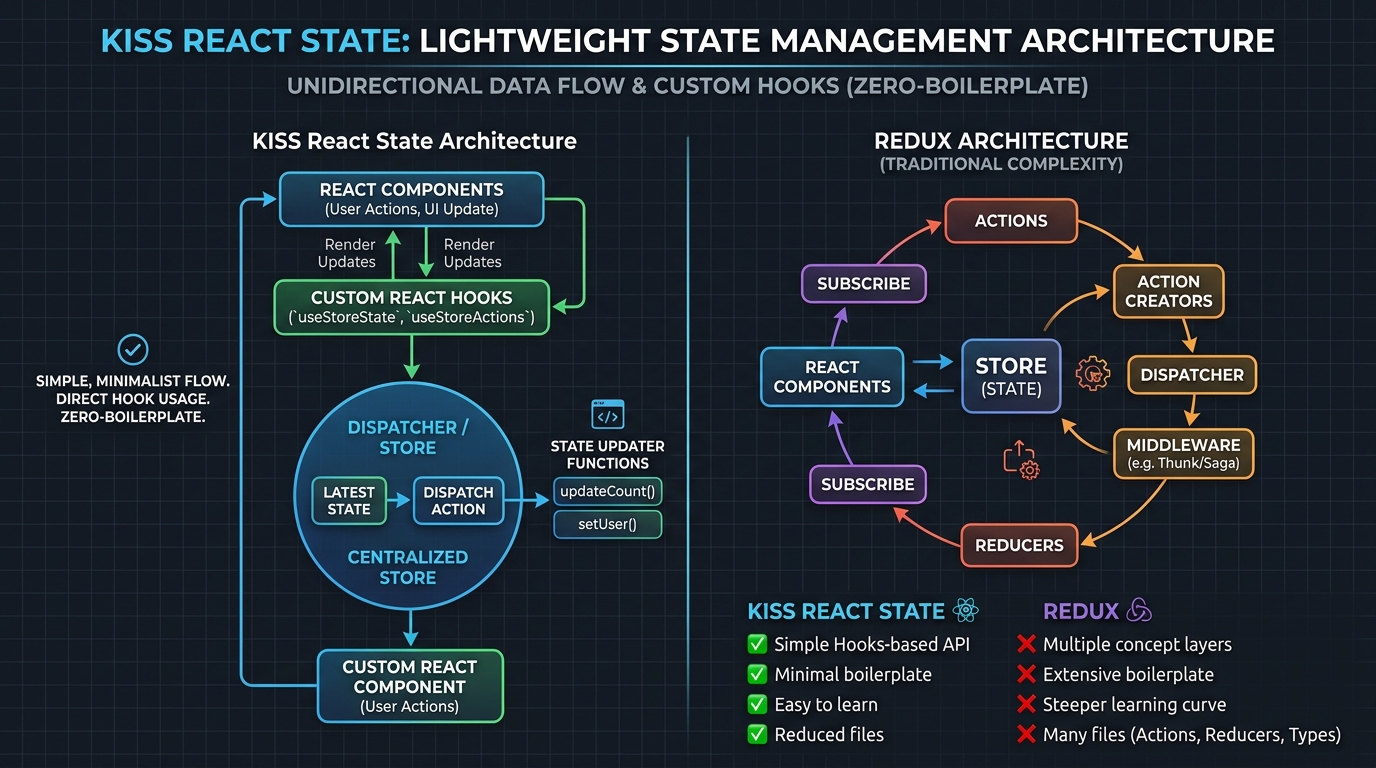
⚠️ Tech Ahead: The sections below explore the custom React Hooks architecture, unidirectional data dispatcher, typed payloads, and async thunk handling.
Architectural Comparison: KISS vs. Redux
| Feature | kiss-react-state |
Traditional Redux |
|---|---|---|
| Boilerplate | Zero (direct hook invocation) | Extensive (actions, reducers, types) |
| Store Connection | Automatic via custom hook | <Provider> wrapping + connect() / selectors |
| Async Operations | Native inline process/thunk actions | Requires redux-thunk or redux-saga |
| Bundle Impact | Ultra-lightweight (<2KB) | Heavier dependency chain |
Technical Mechanics
1. Direct Hook Access
Instead of mapping state to props or creating complex selector trees, components subscribe to state slices directly:
import { useStoreState, useStoreActions } from 'kiss-react-state';

export function UserProfile() {
  const user = useStoreState((state) => state.currentUser);
  const { updateUser, fetchUserData } = useStoreActions();

  return (
    <div>
      <h1>{user.name}</h1>
      <button onClick={() => fetchUserData(user.id)}>Refresh</button>
    </div>
  );
}
2. Unidirectional Action Dispatcher
The internal store maintains an immutable single source of truth:
- Simple Actions: Synchronous state transitions with typed payloads.
- Process Actions: Asynchronous flows (thunks) that yield intermediate loading states without external middleware libraries.
— [ DISPATCH TRANSMISSION COMPLETE // END OF FILE ] —